

Shipping Container Office Planning Guide for 2026
A shipping container office can be a practical, durable, and fast-deploying workspace for construction sites, small businesses, farms, developers, logistics teams, and homeowners. But the best results in 2026 will not come from simply buying a box and adding a desk. A successful shipping container office starts with the right container grade, layout, insulation strategy, site plan, delivery method, and code review.
For buyers in Raleigh, across North Carolina, and throughout the Southeast, planning matters even more because humidity, summer heat, storm exposure, and local zoning requirements can all affect performance. The same is true for national projects, especially when a mobile office needs to be moved between job sites or paired with secure storage.
This guide walks through the key decisions to make before you purchase or modify a container office, with practical advice for choosing between One-Trip, Cargo Worthy, and Wind & Watertight units.
Start with the job your office needs to do
Before comparing sizes or upgrades, define how the office will be used day to day. A field office for a general contractor has different needs than a customer-facing sales office, a farm office, or a compact backyard workspace.
A strong planning brief should answer these questions:
- Who will use the office and how many people need to work inside at one time?
- Will the office be temporary, semi-permanent, or a long-term structure?
- Does the unit need storage for tools, inventory, records, samples, or equipment?
- Will customers, subcontractors, inspectors, or employees enter the space?
- Does the office need power, HVAC, internet, plumbing, security, or ADA-aware access?
For a Raleigh-area builder, for example, the priority may be a durable office with a plan table, HVAC, job files, and secure tool storage. For a small business owner, the priority may be a clean and comfortable workspace that can support inventory overflow or seasonal retail operations. For a logistics manager, the priority may be an ISO-standard structure that can be relocated or integrated into an active yard.
Choose the right container size and layout
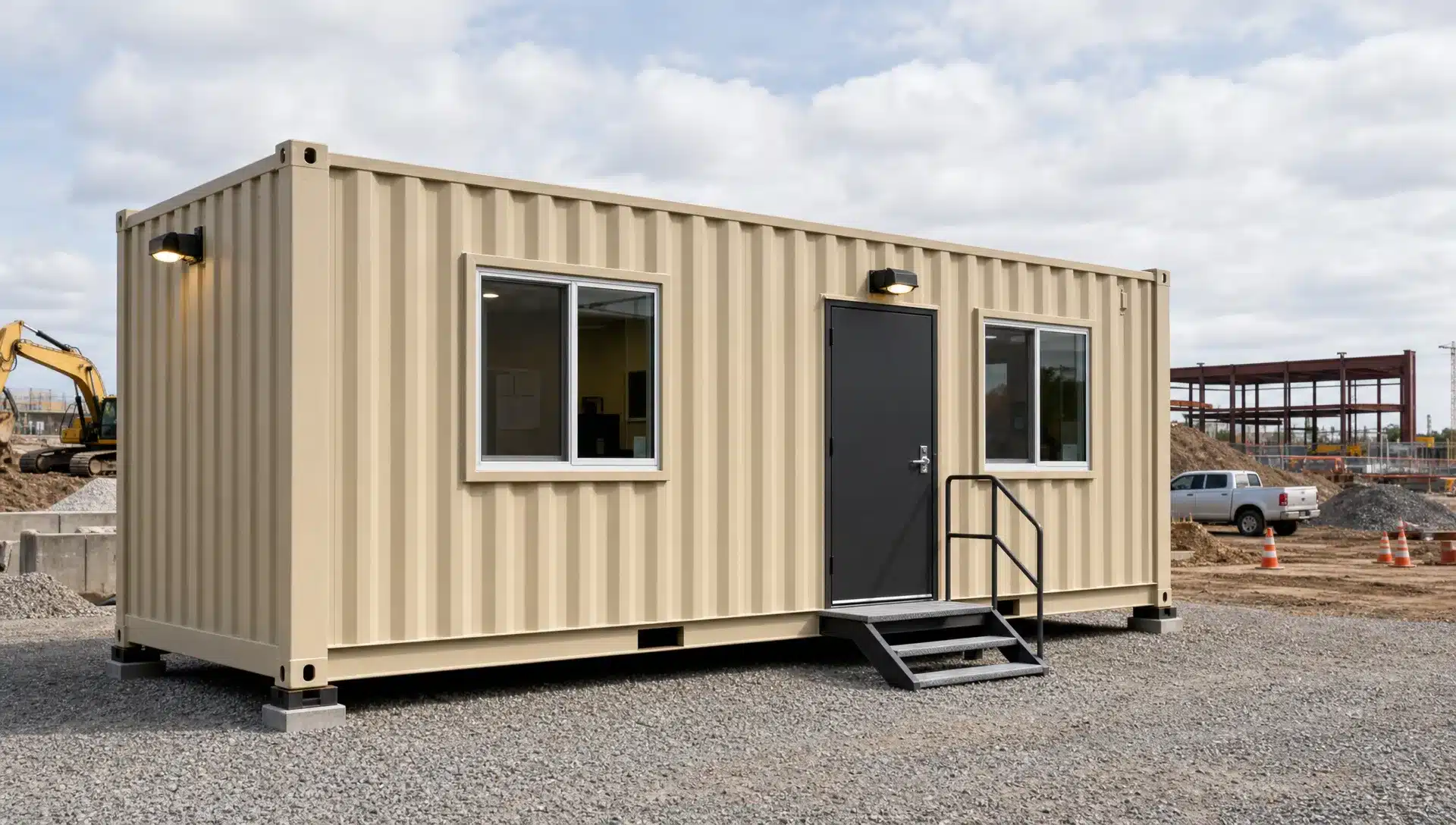
Shipping container offices are commonly planned around 10ft, 20ft, and 40ft footprints, with Standard and High Cube options depending on availability and intended use. Standard dry containers are typically 8ft wide and 8ft 6in tall on the exterior. High Cube containers are typically 9ft 6in tall on the exterior, giving additional vertical space that can help with insulation, lighting, and HVAC clearances.
| Office plan | Typical fit | Best use case | Planning note |
|---|---|---|---|
| 10ft office | Compact single-person workspace | Guard booth, check-in station, small site office, farm office | Works well where space is limited and storage needs are light |
| 20ft office | Small team or solo office with room for files and equipment | Contractor office, home office, small business admin space | Often the most flexible size for properties with limited access |
| 40ft office | Larger team workspace or office plus storage | Construction sites, developers, industrial yards, mobile operations | Requires more delivery clearance and a larger prepared pad |
| High Cube office | Any layout needing extra height | Insulated office, HVAC, ceiling lights, taller users | Valuable in humid or hot climates where comfort systems matter |
If your project needs a compact, durable workspace, a 10ft Shipping Container Office, Portable Corten Steel Workspace Unit can be a practical option for smaller sites where a full 20ft or 40ft footprint is unnecessary.
For larger job sites that need both administrative space and protected storage, a 40ft Mobile Office Shipping Container with Storage (18/22) (40HCMOS1822) is relevant because the office and storage zones are separated within one unit. That kind of layout can reduce clutter, improve security, and help field teams keep paperwork and equipment in the same controlled location.
If you are still comparing the broader market for 20ft options, Lease Lane also has a detailed 20ft container price guide for 2026 buyers that explains how size, condition, delivery, and grade affect budget planning.
Understand container grades before you commit
The grade of the container affects price, appearance, structural confidence, modification potential, and long-term value. For an office conversion, this decision should be made before you select windows, doors, insulation, or electrical work.
Most shipping containers are built from Corten Steel, a weathering steel designed to withstand harsh marine conditions. They are also designed around ISO standards, which is why they can be stacked, transported, and handled by intermodal equipment. Once a container is modified with large openings, added framing, or permanent building systems, the original cargo-handling characteristics may change, so modifications should be planned carefully.
| Grade | What it means | Best office use | What to inspect |
|---|---|---|---|
| One-Trip | A newer container that has typically made one cargo trip before resale | Premium office, retail-facing workspace, long-term professional installation | Paint condition, door operation, floor condition, roof, corner castings |
| Cargo Worthy | A used container considered structurally suitable for cargo transport | Mobile project office, logistics yard office, office that may be relocated | Structural rails, corner posts, roof bows, floor, valid inspection needs |
| Wind & Watertight | A used container that should keep out wind and water but is not certified for cargo transport | Budget-conscious stationary office or storage-office combination | Leaks, rust, door gaskets, floor soft spots, prior repairs |
A One-Trip unit is often the cleanest starting point for a professional office because it typically has fewer dents, less corrosion, and a cleaner appearance. That can matter for customer-facing businesses, real estate development sites, or long-term installations where curb appeal is important.
A Cargo Worthy unit can make sense when the office may need to move between sites or when structural confidence is a top priority. It may still show cosmetic wear, but the key issue is structural suitability.
A Wind & Watertight unit can be cost-effective for a stationary office, especially on a private job site or agricultural property. However, WWT does not mean cargo-certified. It means the unit should resist wind and water intrusion when properly maintained. For offices, always inspect the roof, door seals, flooring, and areas around any existing patches.
For a deeper technical comparison, review Lease Lane’s guide to the best shipping container grades for an office, especially if you are deciding between a used container and a One-Trip unit.
Plan the interior around workflow, not just square footage
A container office should feel efficient, not cramped. The most common planning mistake is filling the floor plan with furniture before deciding how people will enter, move, work, store items, and exit safely.
For a construction office, think about a clear entry point, a desk or plan table, document storage, charging space for devices, and a separate secure area for tools or samples. For a small business, consider customer flow, display space, inventory access, lighting, and climate control. For a home office, think about noise, privacy, internet connectivity, and natural light.
Personnel doors, roll-up doors, windows, vents, partitions, insulation, finished walls, electrical service, LED lighting, data connections, and HVAC should all be considered together. Cutting openings into Corten Steel changes the way the wall handles load and weather, so larger modifications should be reinforced properly.
If you are evaluating which upgrades create the most practical value, Lease Lane’s article on custom shipping container modifications is a useful next step.
Design for insulation, HVAC, and condensation control
In Raleigh and the wider Southeast, heat and humidity are not minor details. A bare steel container can become uncomfortable quickly, and temperature swings can create condensation if the office is not insulated and ventilated correctly.
Common insulation approaches include spray foam, rigid foam board, mineral wool, and framed interior wall systems. Spray foam is often used because it can help reduce air gaps and condensation risk, but each project should be evaluated based on budget, interior finish goals, climate, and code requirements.
High Cube containers are especially useful when insulation and ceiling systems are part of the plan. The added height can help preserve headroom after installing ceiling insulation, lighting, and HVAC distribution. In many office layouts, that extra vertical clearance makes the space feel less confined.
Ventilation is just as important as insulation. A small office with sealed doors and windows can trap humidity, odors, and heat. Plan for fresh air, proper HVAC sizing, and moisture-resistant interior finishes.
Review permits, zoning, and code before delivery
Permit requirements depend on location, use, duration, foundation, utilities, and whether the office is accessible to employees, customers, or the public. In Raleigh, a container used as a temporary construction office may be treated differently than a permanent commercial office, backyard studio, retail pop-up, or accessory structure.
Before buying, contact the authority having jurisdiction for your property. In Raleigh, that may include zoning, building inspections, fire review, utilities, or planning staff depending on the project. The City of Raleigh permits and development services can help property owners and contractors understand local requirements.
Key code and permitting questions include whether the unit needs a building permit, whether zoning allows the use, where the container can be placed, how long it can remain on site, whether electrical work requires a permit, and whether accessibility or egress rules apply. If the office will be open to the public, used by employees, or connected to utilities, the review is usually more involved than a simple storage placement.
For national projects, do not assume rules are the same across counties or states. A container office that is acceptable as a temporary field office in one jurisdiction may need additional approvals in another.
Pro-Tip: Prepare the site before the truck arrives
A clean, level, accessible site is one of the biggest factors in a smooth container office delivery. The best container in the world can become difficult to use if it is dropped on soft soil, placed out of level, or positioned where doors cannot open fully.
For most office installations, start with a firm, level pad. Compacted gravel is often a practical choice because it promotes drainage and reduces mud around the entry. Concrete piers, a concrete slab, or engineered footings may be appropriate for more permanent installations, especially where code, utilities, or heavy occupancy loads are involved.
Leave enough clearance for the delivery truck, not just the container footprint. Tilt-bed and roll-off deliveries need straight-line space to unload. Overhead branches, low wires, tight gates, soft shoulders, steep driveways, and narrow turns can delay delivery or require a different truck plan.
Also plan the finished elevation. If the container office will have steps, a ramp, skirting, utilities, or HVAC equipment, those details should be considered before placement. Moving a loaded or modified container later can be expensive and disruptive.
For a more detailed delivery checklist, review Lease Lane’s container delivery planning guide before scheduling your drop.
Build a realistic 2026 budget
A shipping container office budget should include more than the container shell. The final cost depends on condition, grade, size, delivery distance, modifications, site work, utilities, and local compliance requirements.
| Budget category | What to include | Why it matters |
|---|---|---|
| Container shell | One-Trip, Cargo Worthy, or WWT unit in the chosen size | Grade affects appearance, useful life, and modification value |
| Delivery | Trucking, access needs, unloading method, distance | Delivery constraints can change the total project cost |
| Site preparation | Gravel pad, slab, piers, drainage, grading | A poor base can cause door issues, pooling water, and instability |
| Modifications | Doors, windows, framing, insulation, HVAC, electrical | Office comfort and safety depend on integrated planning |
| Permits and compliance | Zoning review, building permit, electrical permit, inspections | Avoids delays, fines, or forced relocation |
| Interior setup | Desks, shelving, flooring, lighting, data, security | Determines how functional the office is on day one |
| Maintenance | Paint touch-ups, gasket checks, roof inspection, drainage upkeep | Protects the long-term value of the office |
Budget-conscious buyers sometimes start with a WWT used container and focus spending on insulation, electrical, and HVAC. Buyers who need a polished workspace may prefer a One-Trip unit because the cleaner shell can reduce cosmetic prep and improve the finished look.
The most important budgeting principle is to avoid spending heavily on modifications before confirming the container grade, site plan, and permit path.
Think through security and durability
One reason contractors and business owners choose container offices is security. Steel walls, cargo doors, lockboxes, and controlled access can make a container office harder to breach than many temporary structures. That matters on job sites where tools, files, tablets, and materials need to stay protected after hours.
Security planning should include door type, lock protection, lighting, camera placement, and visibility from the street or jobsite entrance. If the office includes storage, consider separating workspace from equipment storage so visitors or subcontractors do not walk through sensitive areas.
Durability also depends on maintenance. Corten Steel is built for tough conditions, but it is not maintenance-free. Keep the roof clear of standing debris, check door gaskets, touch up exposed steel when needed, and maintain drainage around the pad. In humid regions like North Carolina, regular inspection helps prevent minor rust from becoming a larger issue.
Map the project timeline
A smooth container office project usually follows a clear sequence. First, define the use case and required size. Next, confirm the site location, access route, and local permit requirements. Then choose the container grade and layout. After that, finalize modifications, utilities, and delivery timing.
Do not schedule delivery until the placement area is ready and the access route has been measured. If the container will be modified before delivery, confirm whether the finished unit will need special handling because added doors, windows, HVAC equipment, or interior finishes can affect transport planning.
For contractors in the Southeast, it is also smart to plan around weather. Heavy rain can soften access roads and pads. Summer heat can affect working conditions during installation. Storm season may influence anchoring, drainage, and placement decisions.
Common mistakes to avoid
The most common mistake is choosing the cheapest available container without inspecting grade and condition. A low-cost WWT unit can be a good choice for some projects, but not if the roof has active leaks, the doors are difficult to operate, or the floor is compromised.
Another mistake is underestimating heat and condensation. A container office in Raleigh needs a serious plan for insulation, air sealing, ventilation, and HVAC. A fan alone is rarely enough for a comfortable professional workspace.
A third mistake is ignoring the delivery path. Buyers often measure the container footprint but forget to account for the truck, turning radius, overhead clearance, and unloading angle. This is especially important for wooded residential properties, tight urban lots, and active construction sites.
Finally, do not treat permits as an afterthought. Even temporary units can trigger local requirements depending on use, location, utilities, signage, or public access.
Frequently Asked Questions
What is the best container grade for a shipping container office? A One-Trip container is often best for a polished long-term office because it is cleaner and has less wear. Cargo Worthy can work well for mobile or structurally demanding uses. Wind & Watertight can be a cost-effective choice for stationary offices if the unit is carefully inspected for leaks, rust, floor damage, and door issues.
Is a High Cube container worth it for an office? Yes, a High Cube container is often worth considering because the extra exterior height helps preserve interior headroom after insulation, lighting, and HVAC are installed. This is especially useful in hot and humid regions like Raleigh and the Southeast.
Do I need a permit for a container office in Raleigh? It depends on the property, use, duration, foundation, utilities, and whether employees or the public will occupy the space. Always confirm with the local authority having jurisdiction before delivery, especially if the office will have electrical service, HVAC, stairs, ramps, signage, or public access.
Can a used shipping container become a comfortable office? Yes, but the grade and condition matter. A used Cargo Worthy or Wind & Watertight container can be converted into a functional office when the roof, walls, doors, flooring, and structure are sound. Proper insulation, ventilation, HVAC, and moisture control are essential.
How much site preparation does a container office need? At minimum, the site should be level, firm, accessible, and well drained. Many projects use a compacted gravel pad, while longer-term or code-driven installations may require concrete piers, a slab, or engineered footings. The delivery truck also needs enough clearance to place the unit safely.
Plan your 2026 container office with Lease Lane Containers
A shipping container office can be a smart investment when the container grade, layout, site, delivery plan, and permit path are handled correctly from the start. Lease Lane Containers LLC supplies high-quality new One-Trip and used shipping containers, including Standard, High Cube, refrigerated, Cargo Worthy, and Wind & Watertight options, with guidance for Raleigh, North Carolina, the Southeast, and nationwide delivery.
To discuss the right container office for your project, contact the Lease Lane sales team at [email protected] or visit the Raleigh office for local guidance on sizing, grading, site preparation, and delivery planning.